Every job starts with a walk-through at your home.
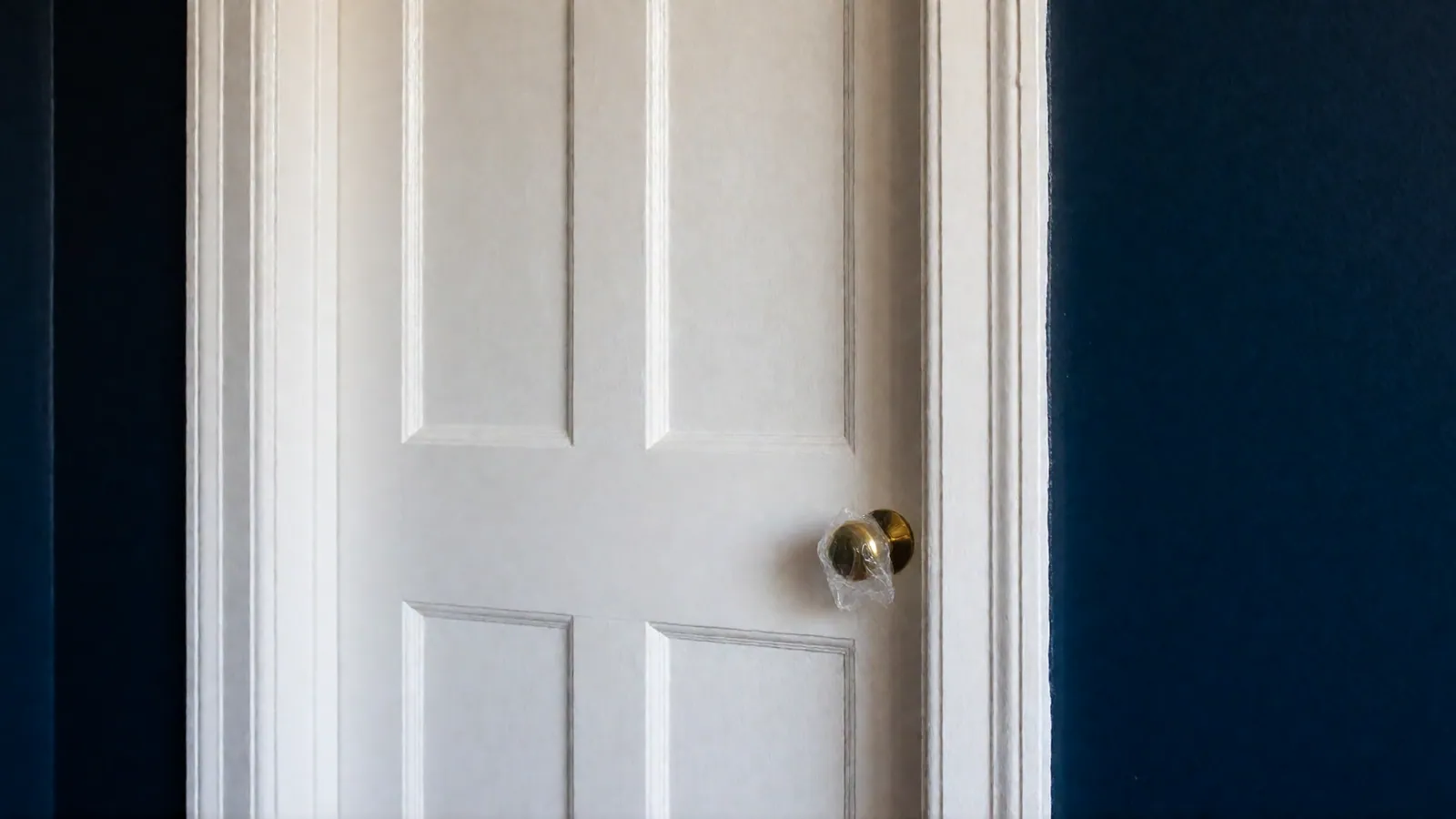
A white six-panel door and its casing freshly enameled, the door's round brass knob wrapped in clear plastic, a deep navy wall on either side meeting the white casing in a straight line.

Painting inside

The parts of a room that show the work

Ceilings, baseboards, moldings, window sashes and doors, in a waterborne enamel, with a straight line at every edge.

  • $70 a painter-hour, plus sales tax
  • Planned in the scope planner
  • Doors and windows by the item

AI-generated illustration. Not a real home or business.

Ceilings: flat, white, and first

A ceiling is lit from the side by every window in the room, and side light is the light that shows every lap and every patch. That is why a ceiling gets a flat white: a flat paint scatters light instead of reflecting it, and a ceiling painted in anything shinier shows the path of the roller from the doorway.

It goes on before the walls, so that whatever falls from the roller lands on a surface still to be painted. A prewar ceiling is high, and the crown molding along its edge is cut in by hand, which is why the planner asks how high the ceilings are; for ceilings higher than ten feet, it counts more time on the ceiling as well as more wall.

A smooth ceiling is painted. A textured one depends on the building's age: in a building from 1987 or later, the planner counts three tenths more of a smooth ceiling's time, because the roller has to be worked into the texture; in an older building it is left out.

A textured ceiling in a building from before 1987 may contain asbestos. In New York City, removing it, or even painting over more than ten square feet of it, is asbestos work: it needs a survey by a City-certified asbestos investigator first, and a licensed asbestos contractor if asbestos is found. We don't do asbestos work, so such a ceiling is left out of the planner's range, and we never remove a textured ceiling.

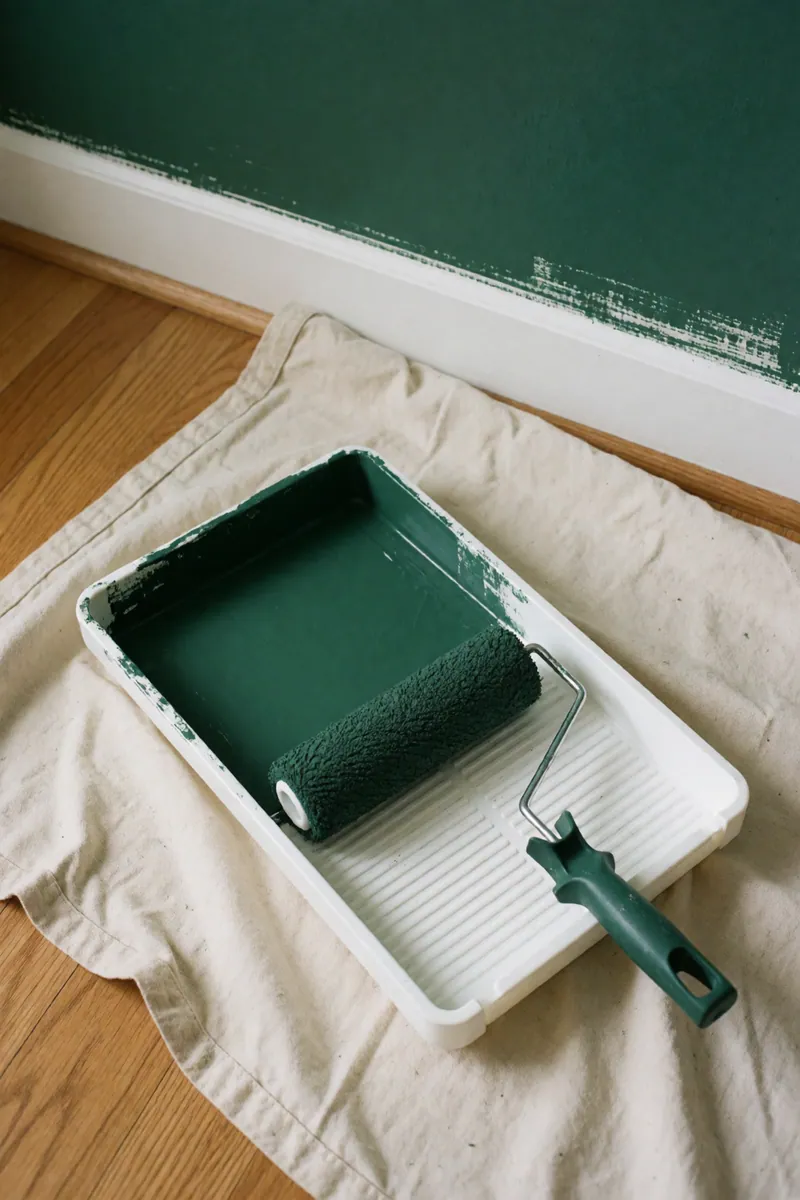
A white roller tray of deep green paint with a roller resting on its ramp, lying on a folded drop cloth by a freshly painted green wall.AI-generated illustration. Not a real home or business.

Casimir Oduya-Hart

Crew lead

Leads the crews in apartments and houses across Queens.

Casimir covers the floor and the furniture before the first brush comes out of its sleeve.

Casimir paints the ceiling first and the trim last, every time.

The picture is a still of the tools, not a portrait.
Trim: baseboards, moldings and windows

Trim is the woodwork a room is handled by: baseboards scuffed by the vacuum cleaner, casings touched on the way past, sills where things are put down. It gets an enamel, satin or semi-gloss, because a shinier film is harder and wipes clean, and because the change of sheen is what makes the edge between wall and trim read as a line.

Before the enamel the gaps are caulked: the seam where the baseboard meets the wall, the joints of the casings, the line along the top of the crown. An open seam shows as a dark line under new paint, and caulk closes it with something that gives when the house moves. Old gloss is sanded dull first, because new paint does not hold to a shine; in an older home that is done wet and by hand.

A double-hung window is painted so that it still opens. The sashes are moved up and down while the paint sets, the channels they slide in are kept clear, and no sash is painted to its frame. A prewar window that will not open has usually been painted shut, not built that way.

  • A door, both faces and the frame.
  • Windows painted so they still open.

Doors, painted flat where they can be

A door painted on its hinges is painted standing up, and enamel on an upright face wants to run. Laid flat, the same enamel levels into a smooth face, and both sides and all four edges can be reached. So where there is room, the door comes off with its hinges and its knob, is painted lying down, and goes back on when it is dry.

Where there is no room to lay a door down, it is painted where it hangs, the hardware covered, and left ajar so that it does not dry stuck to its stop.

The planner counts an hour and a half for a door, both faces and the frame, and an hour and fifteen minutes for a window's sashes, casing and sill. The enamel is charged by the item:

The trim enamel is charged by the item rather than by the gallon. Sales tax is added on the whole bill, at 8.875%.
The itemThe enamel, before sales tax
A door, both faces and the frame, two coats$14
A window: the sashes, the casing and the sill, two coats$9
The inside of a reach-in closet, shelf included$9
Baseboard, for every ten feet$4

A worked example: a textured ceiling left out

Worked out at the published rate and prices. The household is invented.

A worked example: a planning range

A living room with a textured ceiling A 1970s building in Rego Park

The twelve answers behind it
Living or dining rooms
1
Where is it?
Woodside or a neighborhood next to it
How big are the rooms?
About average for New York
How high are the ceilings?
Eight to nine feet, as most newer buildings have
What are we painting in those rooms?
Walls and ceilings
Is any of the ceilings textured, sprayed-on or "popcorn"?
Yes, at least one ceiling has a sprayed-on or popcorn texture
And the doors?
No doors
What shape are the walls in?
Fair: cracks, dents, some flaking at the windows or radiators
And the color?
A new color of about the same depth
How furnished are the rooms?
Furnished, as most homes are
When was the building built?
Between 1960 and 1977
What kind of home is it?
An apartment in a building with three or more apartments (a co-op or condo included)
  • Paintersby the size of the jobOne painter
  • Painter-hoursthe work, counted in whole hours10 to 13 painter-hours
  • Working days on sitewith this crew1½ to 2 working days
  • The ratethe same on every working day$70 a painter-hour
  • The time, at the ratethe painter-hours at the rate$700.00 to $910.00
  • The paint, roughlytwo coats, rounded up to the gallon3 gallons of wall paint
  • Paintby the gallon, at the published prices$216.00
  • Plastic, tape, filler and the restone room, the lead-safe sheeting included$70.00
  • Before sales taxthe time, the paint and the materials$986.00 to $1,196.00
  • Sales tax, 8.875%on the whole bill$87.51 to $106.15
  • The rangea planning range, not an estimate$1,073.51 to $1,302.15
  • Built before 1978: planned lead-safe. It takes longer, and the scope planner counts the time.
  • Left out of the range. A textured ceiling in a building from before 1987 may contain asbestos.

The scope planner's answer to these questions, at the published rate and prices. A planning range is not an estimate or a quote, and nothing on this site is an offer of work.

Related services

Plan your painting

Try the scope planner: a crew, painter-hours and working days at the published rate, in about two minutes. Sending it to us books nothing.