The journal
Going from a dark color to a light one
Why a deep red wall takes a primer before two coats of white, and what that does to the hours and the gallons.
AI-generated illustration. Not a real home or business.
Why white struggles over red
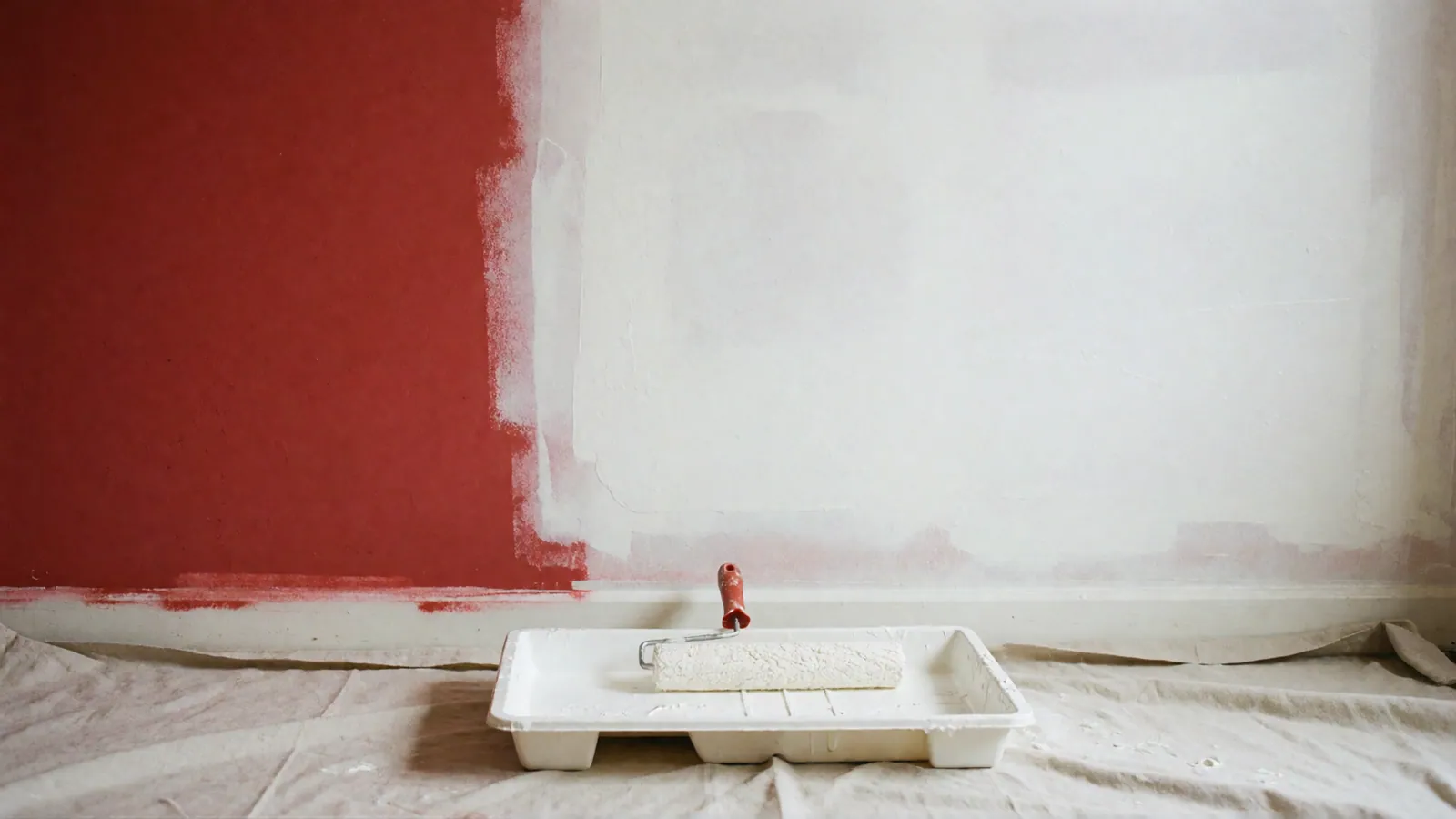
A deep red, a navy or a forest green is mostly colorant, with very little of the white pigment that gives a paint its hiding power. A white or a pale color is the opposite: nearly all of its hiding power is in that white pigment, and over a deep color it runs out. The first coat of white over a red wall goes on pink. The next goes on a paler pink. Often the one after that still shows a warm shadow in the corners and wherever the roller ran light.
Adding coats of white until the red is gone works, eventually, but it is slow, and it spends the finish paint, which costs more by the gallon, on a job the primer does better. A primer does it in one coat, because covering is what a primer is made for: it lays down an even, neutral ground that the finish coats only have to color, not hide.
What the planner does with it
The planner asks about the color in one question, and one of its answers is "A big change: dark to light, or light to a deep color". Choose it and the plan gains a full primer coat over every wall before the two finish coats, and the result says why in a line of its own.
The primer coat is counted like any other coat, at a pace of its own: about 220 square feet an hour, against about 180 for a first coat of wall paint, as the pricing page's table sets out. On the worked example below the walls come to 1,626 square feet. At 300 square feet a gallon, one coat of primer takes six gallons, and the planner counts about seven painter-hours for it before it widens the job into a range.
Which primer
Over a deep color going light, the primer is white. Going the other way, from a pale wall to a deep one, a primer tinted gray, or toward the new color, gives the finish coats a head start, because a deep color has the same weakness on the way up as white has on the way down: not much hiding power of its own. Where the old color is a stain as much as a color, smoke, a water mark, marker on a child's bedroom wall, the primer is a stain-blocking one, which is what the paint list means by "Primer, stain-blocking where it needs to be".
Deep colors have one more habit worth knowing. Even over a good primer, some take another finish coat to look even, the clear, saturated reds and yellows above all, and nobody can say in advance which ones will. The planner counts two finish coats, and the walk-through and the first coat are where a third is spotted, if the color needs one:
What the answers can miss. What moves a range at the walk-through: walls in worse shape than the answers said, more doors or windows, a color that needs a third coat, furniture nobody mentioned, a building's short working hours, and a ceiling that turns out to be textured.
The worked example
One of the worked examples is exactly this job: two bedrooms and a living room, dark to light, in a 1950s co-op in Woodside. The walls are in poor shape as well as dark, and the building is from before 1978, so the range carries the primer, the extra preparation, the time an older home's paint takes, and a day for the filler to dry:
A worked example: a planning range
Two bedrooms and a living room, dark to light A 1950s co-op in Woodside
The fourteen answers behind it
- Bedrooms
- 2
- Living or dining rooms
- 1
- Hallways and entries
- 1
- Where is it?
- Woodside or a neighborhood next to it
- How big are the rooms?
- About average for New York
- How high are the ceilings?
- Nine to ten feet, as many prewar buildings have
- What are we painting in those rooms?
- Walls and ceilings
- Is any of the ceilings textured, sprayed-on or "popcorn"?
- No, the ceilings are smooth
- And the doors?
- The doors of these rooms, both sides and the frames
- What shape are the walls in?
- Poor: many cracks, old patches and flaking paint, but the plaster is sound
- And the color?
- A big change: dark to light, or light to a deep color
- How furnished are the rooms?
- Furnished, as most homes are
- When was the building built?
- Before 1960
- What kind of home is it?
- An apartment in a building with three or more apartments (a co-op or condo included)
- Paintersby the size of the jobTwo painters
- Painter-hoursthe work, counted in whole hours62 to 87 painter-hours
- Working days on sitewith this crew, and a day for the filler to dry5 to 6½ working days
- The ratethe same on every working day$70 a painter-hour
- The time, at the ratethe painter-hours at the rate$4,340.00 to $6,090.00
- The paint, roughlytwo coats and a primer coat, rounded up to the gallon10 gallons of wall paint, 4 of ceiling paint and 6 of primer
- Paintby the gallon, and the trim enamel by the item$1,270.00
- Plastic, tape, filler and the restfour rooms together, the lead-safe sheeting included$280.00
- Before sales taxthe time, the paint and the materials$5,890.00 to $7,640.00
- Sales tax, 8.875%on the whole bill$522.74 to $678.05
- The rangea planning range, not an estimate$6,412.74 to $8,318.05
- Built before 1978: planned lead-safe. It takes longer, and the scope planner counts the time.
- One more day, because heavy filling dries overnight before it is sanded and primed.
- A primer coat first, because of the big color change.
The scope planner's answer to these questions, at the published rate and prices. A planning range is not an estimate or a quote, and nothing on this site is an offer of work.
Read the lines under the range together. The drying day is not painting time and is not counted in painter-hours: it is a day on which the job waits, so the working days stretch while the hours do not. The primer is the opposite: it is painting time, and it is in the hours.
Before you choose the light color
Choose the new color over the primer, not over the old one. A white sample brushed straight onto a red wall looks warmer than it will, because the red glows through it; on a primed board, or a primed patch of the wall, it looks like itself. That is one reason the samples are brushed after the walk-through, on the wall, in your own light:
Your choice, tested at home. You choose the colors, from any maker's colors; we brush a few large samples on the wall after the walk-through so you can see them in your own light, morning and evening.
Then give the room a few days. The first evening with the furniture back, a room that was dark can feel bare. If it still feels wrong after you have lived in it for a while, the answer is usually a warmer white, not a return to the dark.
Plan your painting
Try the scope planner: a crew, painter-hours and working days at the published rate, in about two minutes. Sending it to us books nothing.